I have been in a lot of Melbourne buildings, and a lot of our students' properties. This one stood out from the door. Rukmani runs a two-bedroom apartment in South Melbourne with her husband, and she got her first listing up in April. When we filmed, it had been going for about four months.
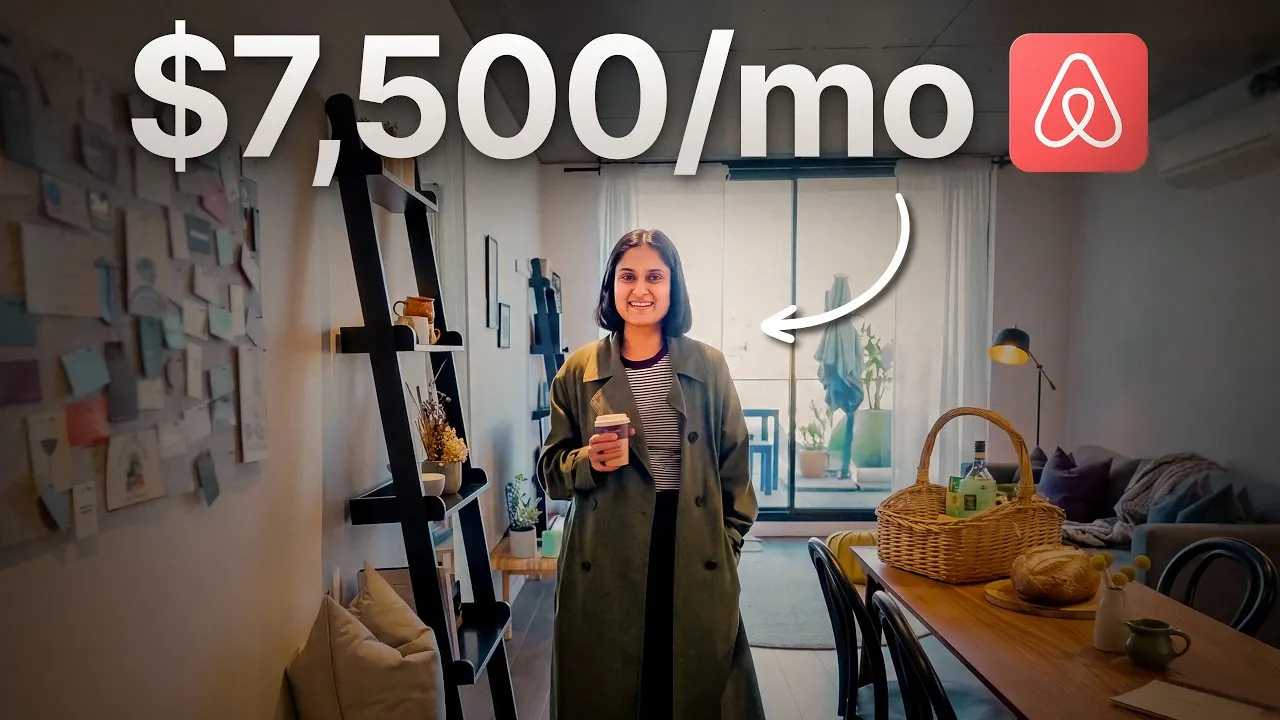 Play the video: Inside The Airbnb That Makes $7,500/Month
The numbers
I asked her straight. The rent is $920 a week. The month before we filmed, the place paid out about $7,500, and she put the profit at about $3,000. Her upfront cost was about $12,000, and that included the first month's rent.
The apartment came mostly furnished, which helped. Furnishing came to about $3,000: small decor pieces, a fully furnished second bedroom, curtains and blinds, and a few upgrades. They love thrifting, so around 90% of what is in there is thrifted or from Marketplace. Apart from linen, they bought almost nothing new, and used Kmart only where they had to.
Her rating was 4.93. She had Guest Favourite before she had Superhost, and she has both now.
She started in the dead season
April is about the worst month to launch in Melbourne. Most listings struggle from April to June. They told me it took a few goes to understand revenue management, and that they could probably have made a bit more in April before they worked out how to discount properly after May. Even so, the listing performed well through the quietest months of the year.
When we filmed in August, the bookings already on the calendar covered the rent for every month ahead except October, which had none yet. September was booked for 14 days, and that alone covered the rent. Their biggest booking was already in for New Year's: about $5,000 for seven days. That is why I keep telling people that summer is where most of the profit is made. A listing with a strong reputation going into October is in a very different position from one that is still finding its feet.
“Without the team and without this mentorship program, Airbnb arbitrage is a risky business.”
Why it does not feel like every other Airbnb
Most short stays turn into a commodity in the guest's head. You stay, you leave, and it was just another Airbnb. Rukmani built a brand instead, called Brick and Bloom, and you can see it in the details:
- A green, moody bedroom with a king bed, which she wants to feel like a boutique stay.
- A welcome basket, and bread for guests on longer stays.
- A guest book that covers the house rules and how to use every room.
- A message before each stay asking whether guests are celebrating anything, and croissants or something extra when they are.
- A board of places past guests have been, so new guests can see the recommendations.
They also listen to feedback and act on it. They upgraded the bathroom amenities after guests mentioned them, and added heaters for winter for guests coming from warmer parts of Asia. That loop matters, because Airbnb's algorithm has moved from being host-centric to guest-centric. They have plenty of listings now. What they are pushing is the guest experience.
How she got the place
It took about four months to land the first property. For the first two weeks they looked at every apartment block in the city, and with a young family that did not work for them. So they went back to the whiteboard and asked what they actually wanted out of it. The answer was unique homes, Victorian houses and unusual apartments, which made the search slower because fewer owners were open to the idea.
They went in prepared. When they applied through agents, they brought a profile and an owner proposal, put together with almost the same detail as the guest book.
Terence and I scaled the other way. We went for volume, more properties side by side. Rukmani is going for fewer properties that each earn more, which I call vertical acquisition. Our blueprint leans towards volume, and they told me that did not suit their lifestyle. That is fine. Everyone's family, money and time situation is different, and the point is to find the version that works for you.
What is next
They have two more on the way, all going well. One is a four-bedroom Victorian home in West Melbourne that comes fully furnished. The owners had it on Airbnb themselves for the last five years, and it came through an agent who still remembered them from a property they had looked at a couple of months earlier. Agent relationships are everything. The other is a recently renovated two-bed, one-bath Victorian in South Melbourne, at $825 a week.
The hardest part for them so far has been letting go. They had been cleaning the place themselves, because they wanted someone who would treat it the way they do, and they knew that was not sustainable if they wanted to scale. Operations are the foundation, so it is worth investing in the right people the same way you invest in the styling.
At the end of the tour we sat down with her listing and her numbers. That audit is the next post: what I changed on her listing, and why.
If you want to see how the model works from the start, the free training walks through it. For the rules you need in place before you sign anything, read rental arbitrage in Australia. And if you would rather start with how Terence and I began, here is the story.